The first king of the English
Æthelstan, the First King of England
Æthelstan, often written Athelstan, was the first king to rule the whole of England. He was the eldest grandson of Alfred the Great, and the eldest son of the king who preceded him, his father, Edward the Elder. He took the Viking kingdom of York in 927 and brought all the English under one king for the first time. He reigned from 924 until his death in 939.
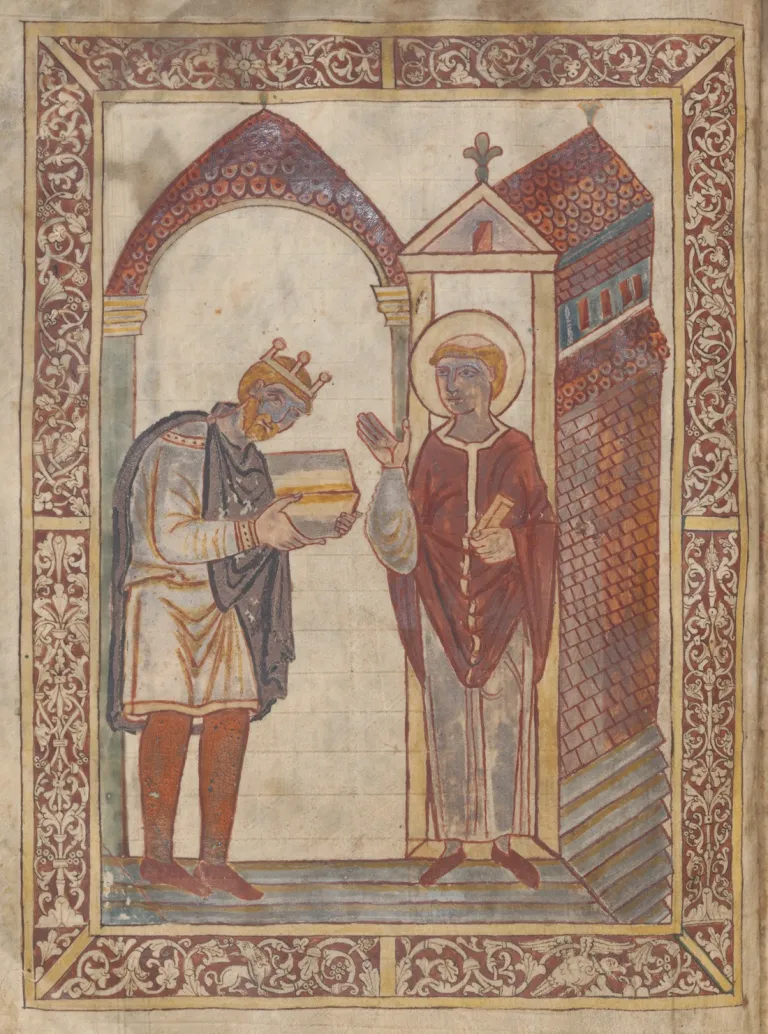
His life and reign
Æthelstan was born around 895, but because his father remarried, he was brought up in Mercia by his aunt Æthelflæd, Lady of the Mercians.
When Edward died in 924, after some delay Æthelstan was chosen as king of Wessex and Mercia, and he was crowned at Kingston upon Thames on 4th September 925. On that day Æthelstan became King of the Anglo-Saxons, the title his father had held.
In 927 he drove the Norse king Guthfrith out of York and took the Viking kingdom for himself. For the first time, one king ruled all the English.
The new kingdom was tested in 937, when Constantine of the Scots, Owain of Strathclyde and Olaf Guthfrithson, king of Dublin, invaded together. Æthelstan and his half brother Edmund defeated them at the Battle of Brunanburh, a victory the Anglo-Saxon Chronicle celebrates in a poem.
Where England began
12th July 927 at Eamont

After Æthelstan took Northumbria in 927, the Anglo-Saxon Chronicle records that the other rulers of Britain came to terms with him: Hywel Dda, king of the West Welsh; Constantine II, king of the Scots; Owain ap Hywel, king of the Welsh and Ealdred of Bamburgh. All these kings and noblemen sealed the peace with pledges and oaths at Eamont, on the fourth day before the ides of July. That is 12th July.
The place where these kings met is still there. The River Eamont runs just south of Penrith in Cumbria, to join with the River Lowther at a point overlooked by the current Brougham Castle. Brougham Hall, where the Birth of England festival weekend will be held in July 2027, can be seen from the vantage point of Brocavum Roman Fort, situated along the old Roman road from York to Carlisle.
How Æthelstan died, and where he is buried
Æthelstan died at Gloucester on 27th October 939, after a reign the Anglo-Saxon Chronicle puts at fourteen years and ten weeks. The Chronicle records where and when he died, but not how.
He was buried at Malmesbury Abbey in Wiltshire, which he had rebuilt and endowed.
Who came after him
His half brother Edmund, who had fought beside him at Brunanburh, became king at eighteen.
The unity Æthelstan built was soon tested. After his death Olaf Guthfrithson, the Norse king of Dublin, took Northumbria, and Edmund did not win it back until 944.
Questions people ask
Who was the first king of England?
Æthelstan, who reigned from 924 to 939, was the first king to rule the whole of England. Earlier kings, his grandfather Alfred the Great among them, ruled Wessex and other kingdoms, but Æthelstan was the first to rule all the English, after he took the Viking kingdom of York in 927.
When was England founded?
England as one kingdom dates from 927. That year Æthelstan took the Viking kingdom of York, bringing all the English under one king, and on 12th July 927 the other kings of Britain met him at Eamont to make peace.
Where was England founded?
At a place the Anglo-Saxon Chronicle describes as ‘eamotum’. In the last century this was interpreted as Eamont, although that village did not exist in 927. Our project has determined that the actual meeting place in 927 was most likely to be Brocavum Roman Fort, which overlooks the confluence of the 2 rivers, Eamont and Lowther.
What happened at Eamont in 927?
On 12th July 927 Hywel Dda, king of the West Welsh; Constantine II, king of the Scots; Owain ap Hywel, king of the Welsh and Ealdred of Bamburgh met Æthelstan at Eamont. They made peace with Æthelstan, he met them with pledges and oaths, as the Anglo-Saxon Chronicle records.
When is England’s birthday?
12th July. The Birth of England campaign marks 12th July 927 as the day England began, which makes 12th July 2027 its 1100th birthday.
What were the Anglo-Saxon kingdoms?
The kingdoms the Anglo-Saxons founded in England from the late 5th century, often called the Heptarchy: Northumbria, Mercia, East Anglia, Essex, Kent, Sussex and Wessex. Danish armies destroyed most of them in the second half of the 9th century.
Eleven hundred years on
On 12th July 2027 England turns 1100. The Birth of England campaign is marking it with a festival weekend at Brougham Hall, near Eamont.